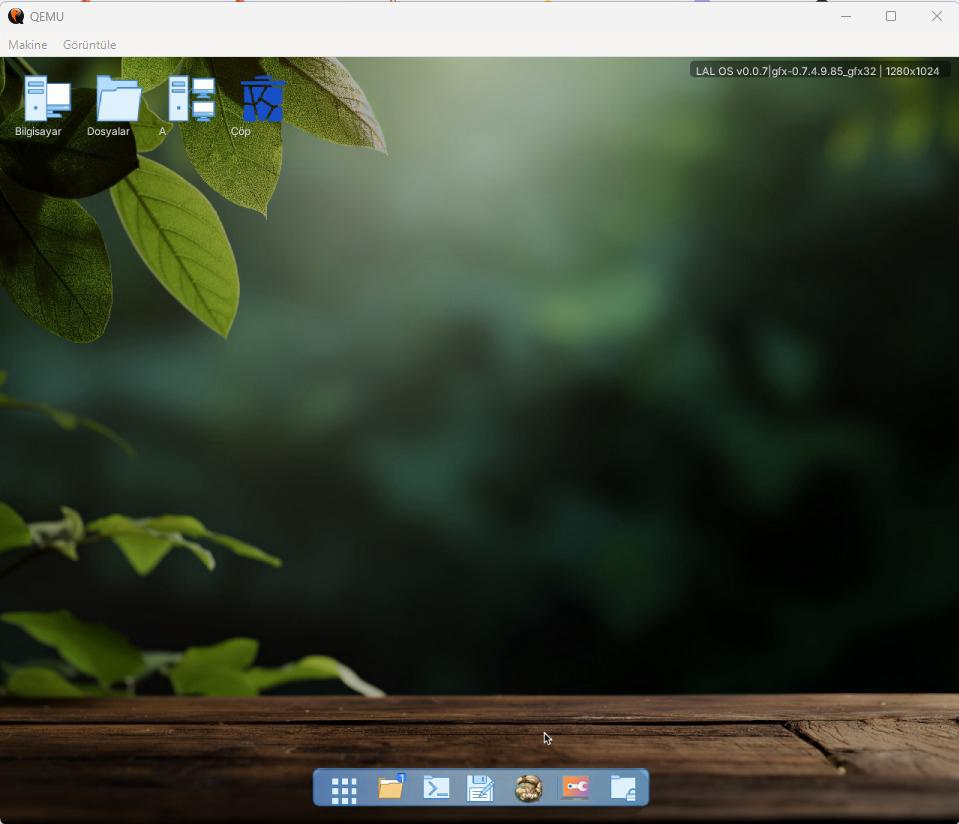
100% Turkish National Operating System

LAL OS

We are building the operating system itself from scratch.

LAL OS is a Turkish national operating system developed from scratch by QBS Software and Information Technologies, with its core operating-system layers owned and developed by QBS. It does not depend on another operating-system kernel, userland or desktop stack; its own kernel architecture, BigArena memory approach, ZuzuGrafik engine, compositor/display layer, Mozaik Desktop, component system, system services and application model form the platform.

LAL OS
DETAILED OVERVIEW

A fully QBS-owned national operating system developed from scratch

LAL OS is an original operating system developed from scratch by QBS Software and Information Technologies. Its kernel, boot, memory management, graphics engine, compositor, window system, desktop, component infrastructure, system services and application model are developed as LAL OS system layers.

The vision is broader than a desktop interface: LAL OS targets a secure, auditable national system platform that can be adapted for public-sector, defense, critical-infrastructure, education, healthcare, finance, industrial and enterprise environments.

100% QBS-owned code base

Core operating-system layers are developed by QBS without binding critical system architecture to a third-party kernel or desktop stack.

Bare-metal system direction

Boot, kernel, memory, display and service layers are designed around the platform’s own low-level system architecture.

32-bit and 64-bit

The current execution path advances on 32-bit architecture while a 64-bit LAL OS is part of the roadmap.

ZuzuGrafik + Mozaik

Graphics, presentation, windows and desktop are developed inside one system architecture.

Motif programming language

A core part of the native LAL OS software-development ecosystem.

Secure system platform

Kernel/user separation, resource ownership, user sessions, service control and a native package model are part of the security direction.

CAPABILITIES

Operating-system architecture developed from scratch

LAL OS system layers are developed under a single architecture.

System foundation

  • LAL Kernel and system bootstrap
  • Low-level hardware and system preparation
  • Shared foundation for kernel resources and system services
  • Closed-source institutional architecture with critical layers developed by QBS

System layers

  • Boot and startup chain
  • Kernel and memory management
  • Display and framebuffer
  • ZuzuGrafik and compositor
  • Window System and component architecture
  • Mozaik Desktop and system services

Independence model

  • Not a desktop product tied to another operating-system infrastructure
  • Own graphics, window, memory and service model
  • Native application and developer ecosystem
  • Reduced dependency in critical system layers
CAPABILITIES

Kernel, BigArena and memory architecture

Memory ownership and separation between graphics, system services and user applications are central to the architecture.

2 GB Kernel / 2 GB User

  • 2 GB kernel space and 2 GB user space in the 32-bit address model
  • Separation of kernel/services from user applications
  • Architecture boundaries intended to improve system stability

BigArena

  • Controlled management of large memory blocks
  • Window-surface and graphics-resource memory accounting
  • Framebuffer, backing surfaces and large buffers
  • Separation of GUI/application resources from early-system memory

32-bit / 64-bit direction

  • Current gfx32 / 32-bit development path
  • Kernel/user separation in 32-bit architecture
  • 64-bit LAL OS direction with expanded address space
CAPABILITIES

ZuzuGrafik, compositor and Mozaik Desktop

LAL OS graphics and desktop layers are built on the platform’s own display path rather than a ready-made UI framework.

ZuzuGrafik Engine

  • 2D rendering and graphics-context model
  • Framebuffer and surface drawing targets
  • Layer and component-paint architecture
  • Atlas, skin and theme resources
  • Dirty-region and partial-repaint direction

Compositor & Display

  • Composition of window surfaces
  • Z-order and layer ordering
  • Dirty-region tracking
  • Centralized display presentation

Mozaik Desktop

  • Login, desktop, dock and launcher
  • Window focus, movement, z-order and lifecycle
  • System Settings and tools
  • Component-based UI architecture
  • Gerrok, LALedit, Terminal and native applications
CAPABILITIES

Motif programming language and the LAL OS application ecosystem

LAL OS aims to build its own software-development culture and native application model together with the operating system.

Motif

  • A Turkish programming-language direction for the LAL OS ecosystem
  • Goal: as approachable as BASIC and as capable as C/Pascal
  • A common model for system and desktop development
  • Integration direction with Mozaik components and system services

Native applications

  • Gerrok file manager
  • LALedit editor
  • Terminal / Mozaik GUI Shell
  • System Settings and System Services
  • LALDiag diagnostics
  • E-Vliya browser direction

Java / OpenJDK workspace

  • OpenJDK runtime workspace inside the LAL OS filesystem
  • Integration work around JAVA_HOME, Java binary, JVM and module model
  • Direction toward the native exec/process layer
CAPABILITIES

Native applications and multi-package compatibility

The primary goal is a native LAL OS application ecosystem, with compatibility layers expanding the range of software the platform can run.

Native LAL OS packages

  • LAL OS application/package distribution model
  • Motif-based native applications
  • Natural integration with system services and Mozaik UI

Windows application compatibility

  • Targeted compatibility/execution layer for Windows .exe applications
  • Application lifecycle managed within LAL OS resource and security rules

macOS and Linux package compatibility

  • Compatibility direction for macOS application/package formats
  • Compatibility direction for Linux applications/packages
  • Running external formats inside LAL OS security and package boundaries
CAPABILITIES

Security and strategic deployment architecture

Security spans memory, services, packages, applications and system resources rather than only the user-login layer.

System security

  • Kernel-space / user-space separation
  • Resource ownership and memory boundaries
  • Controlled service startup and status management
  • User-session/login layer
  • Closed-source critical implementation

Application and package security

  • Application lifecycle controlled by system services
  • Managed package installation/execution model
  • Compatibility layers targeted to run inside LAL OS trust boundaries

Strategic deployment

  • Public institutions and municipalities
  • Defense and military environments
  • Critical infrastructure and closed networks
  • Education, healthcare, finance and industry
  • Enterprise workstations and specialized terminals
CAPABILITIES

LAL OS development direction

System foundation

  • Kernel, boot, display and memory architecture
  • Maturing the 32-bit system path
  • 64-bit architecture and expanded address space

Desktop and applications

  • ZuzuGrafik, compositor and Mozaik Desktop
  • Component library and native system tools
  • Motif language and developer tools
  • E-Vliya and native application ecosystem

Ecosystem and security

  • Native LAL OS package model
  • .exe, macOS and Linux package compatibility
  • Enterprise/public-sector security layers
  • Platform maturity for critical-system deployment
FAQ

Frequently asked questions

What infrastructure does LAL OS use?+

LAL OS is developed with its own system layers without relying on another operating-system kernel, userland or desktop stack.

Who owns the LAL OS source code?+

Core LAL OS system components and critical source code are developed within QBS Software and Information Technologies.

Will LAL OS support both 32-bit and 64-bit?+

The current development path is 32-bit. A 64-bit LAL OS architecture with expanded address space is part of the product roadmap.

What is Motif?+

Motif is the Turkish programming-language direction for the LAL OS ecosystem, intended to unify system and desktop application development.

What about Windows .exe, macOS and Linux applications?+

The primary direction is a native LAL OS ecosystem, with compatibility and execution layers for Windows .exe, macOS and Linux package formats included in the roadmap.

QBS PARTNER NETWORK

Find a partner specialized in LAL OS.

The product showroom filters the authorized network by product capability.

Open partner showroom →

See LAL OS with your own scenario.

Book a demo →